Tag: cooking

  • Curry Surprise

    There is a graphic design story that I read about a decade ago that goes something like this: nearly everyone hate the font “comic sans” and turns their noses up whenever it turns up printed across an amature bit of graphic design work. But as much as some might scorn the folks who use that font, the alternative perspective is simply that … as bad as that font might be … people who use comic sans are still thinking about fonts, design, and breaking out of the old standard font library that comes default with their computer.

    Even if you don’t care about fonts or design, the moral of the little parable is simply that people who try, even if their attempt is mediocre by professional standards, are still people who try.

    Trying is the first step to learning.

    I bring this up only because back in university I was a terrible cook… but I tried.

    What is something you ate 25 years ago that you’d never eat now?

    My wife (who I was merely dating at the time) calls it curry surprise.

    Ground beef, curry paste, cooked noodles, cheddar cheese, and … well, serve hot.

    Or better, don’t serve… and just eat alone in front of the television before you go back to your bedroom and hit the homework for the evening.

    It wasn’t great. It was a student meal.

    But I cooked it routinely because it was simple, filling, hit multiple food groups, and (honestly) none of my roomates would steal my leftovers.

    We laugh at it now and every so often I offer to cook my wife a helping of curry surprise, but I look back on those days of experimenting with weird (and akward) variations as my cooking-slash-comic-sans moment. Cringe-inducing and not worth considering for anything serious, but yet dabbling and thinking about food, cooking, and those first steps to being better in the kitchen as an adult.

  • I Heart Sourdough

    Describe your 2021 in food.

    I had a lengthy post planned about all the different ways in which this blog has forced me to think about how I cook and what I eat and the enjoyment I get out of both those things…

    …then this morning I sliced open a freshly baked loaf of sourdough bread and saw an air bubble in the shape of a heart, and I couldn’t really top that with any more words.

    So.

    That about sums it up I think.

  • Backyard Ribs: Part One, The Rub

    It’s the first Saturday in May and I woke up to a clear blue sky and a weather forecast that was begging for a day outdoors.

    It’s always a gamble, of course, to plan twelve hours ahead of your cooking time for a backyard grill, particularly something as elaborate as a fire smoking some pork ribs. The rain could appear over the horizon and soak the suburbs. The weather could turn cold on a dime still this early in the season. Or the wind could push through and make building a fire a hurculean feat.

    I took the gamble, though.

    I had my reasons for stopping by a new local grocery store last night and a big one point five kilogram pack of ribs caught my eye. “I’m making ribs on the fire tomorrow.” I told my wife as stocked up the fridge with my purchases upon returning home.

    “Oooh. Yum!” She replied.

    “I’m also making it up as I go along.” I told her.

    That got a less enthusiastic response.

    I’ve never grilled ribs over an open fire, so tonight is going to be an adventure. It’s a new-to-me process, but makes use of lots of practiced skills that add up to what I hope will be a success. So, I’ll start with what I know, a basic dry rub and about eight hours in the fridge to let it season up a bit.

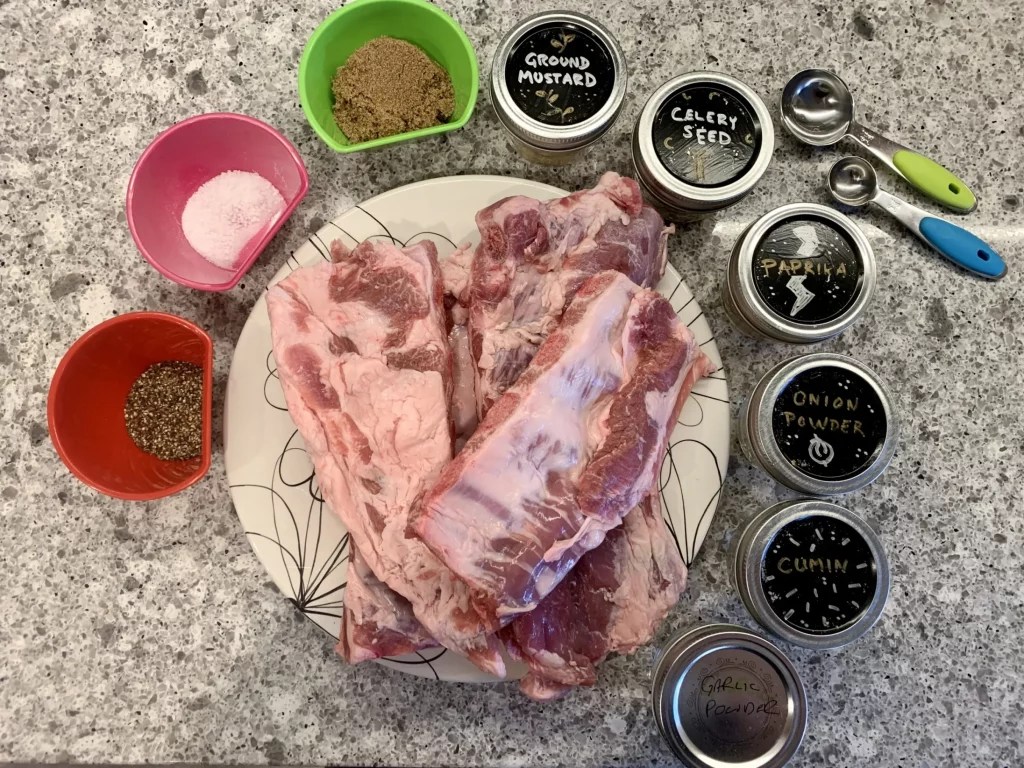
    Dry Rub Recipe

    60ml brown sugar
    15ml salt
    15ml ground black pepper
    15ml paprika
    30ml garlic powder
    30ml onion powder
    10ml ground celery seed
    10ml ground mustard
    10ml cumin

    I spread this evenly on the washed and dried ribs. There was enough in this batch for about 2kg of meat, so I had a little bit left over when everything had been generously coated and wrapped.

    Dry rubs have a couple of positive features I’m looking for in their use: Flavour. Tenderizing. Simplicty. And more, I’m sure.

    I don’t have much room in the fridge for a big old marinade right now, either, and we’ve been trying to cut back on single-use plastic like large zip bags (he writes as he posts a photo of cling wrap on his countertop.)

    But for more important results, back to things like flavour and texture. If you look at the recipe, for example, this particular rub has a solid tablespoon of salt. Eight hours resting in that much salt has an effect on the meat that is essentially a preliminary cure. It’s not going to make this into a true cure of the meat, but it will start to draw some of the moisture from the tissue and will have a tenderizing effect on the final texture.

    My basic rub recipe also has a lot of sugar. Partly, it’s there to even out the spices. Literally. The sugar is a good way to bulk up the rub and make sure it spreads evenly across the meat and doesn’t concentrate too much of the spice unevenly as my untrained hands dash it across the raw flesh. Also, while I’ll add a sauce when I put these over the fire, that sugar in the rub will be the start of the carmelization during the first exposure to heat that will crank up the sticky sweet flavour many people associate with ribs.

    The cooking of these gorgeous hunks of meat will happen later today, and I’ll photograph and post the results in the upcoming part two.

    For now, cross your fingers for that weather holding out!

  • Our Well-Loved Cookbooks: How to Cook Everything

    Had I realized how often over the last fifteen years I would be referencing Mark Bittman’s How to Cook Everything I would have splurged for the hardcover edition.

    As it stands, our trusty copy of this loaf of paper filled with basic recipes rarely makes it back onto the bookshelf, and is so tattered and splattered, I’ll likely be lamenting it’s numbered days before it stops being useful.

    I’ve started a small series of cookbook posts here on castironguy.ca because despite adding to my collection almost monthly, I find that most cookbooks are only useful or interesting in a limited way. Sure, you can learn a great recipe from almost any book out there, and half the fun is picking something that looks like a challenge or a tasty goal, and seeing how well your skills match with the intended product. That said, there are perhaps only a dozen cookbooks on our shelf that would make a cull if I was forced to simplify my library… and these are them.

    The best analogy I have for this book is that it’s like my paperback edition of Google.

    You know those times you are standing there in your kitchen, hands covered in flour, thinking about how you are actually supposed to be cooking something, say a roast or a whole spaghetti squash or maybe a pie crust.

    How long at what temperature?

    How much water was I supposed to add?

    Should I be covering this?

    Today I might Google it, or ask my digital assistant. Hey, Alexa, how do I… ?

    But even still, and especially back when I bought this, it was and still is that one reference book that gives solid, simple advice on the nuances of basic food prep.

    Sure, there are a few fancy recipes hiding in it’s pages, and lots of ideas about stuff like how to make your waffles more interesting, or how to spice a whole chicken, or variations on making your own salad dressings. But the core function of this book is basically aimed at people like me who mostly know enough to get started, have the ingredients in their hands, but are stumped on locking down the process. The how-to. The what was that one crucial step or ingredient that is going to change the outcome if I get it wrong. A reference guide.

    This might not be the exact title for you, but there are a few big reference cookbooks out there with a similar purpose and you should generally keep one on your shelf. I do.

  • Our Well-Loved Cookbooks: Flour Water Salt Yeast

    So . . . I ordered yet another cookbook yesterday.

    I’ve recently been watching a cooking channel on YouTube (perhaps one you have heard of, unlikely one you figured I’d watch) and the host released a cookbook last year, so I splurged. Until a make a few recipes from the book itself, I don’t feel that I’m in a solid or fair position to offer a review or opinion. Hopefully in about a month or so (after I spin up a few of the recipes and get a sense of the style) you’ll see such a post here. Until then…

    My lacking of an opinion is not the case with Ken Forkish’s Flour Water Salt Yeast.

    I remember when my newly kindled interest in sourdough bread-making started to really heat up. I’d begun culturing a starter and then I went scouring the internet for advice. A lot of people recommended this particular tome. I added it to my collection and spent a few solid days reading the details, pondering the techniques and anticipating my next loaf… mostly because that first starter was still pretty new and not ready to use.

    I could write a lot about this cookbook.

    I could tell you that the tone has always struck me in the same way as I felt when I worked my way through university and had this one lab-rat job for a boss who had a PhD in molecular biology and couldn’t believe he had to explain this stuff to me and fine, but pay attention and do you mind if I crank up the radio and we’re all going out for beers after work, you in? Pleasantly mentoring? Friendly condescending? Lovable know-it-all-ish?

    Or, I could tell you that within the words contained on these pages there is as much elaborate history and detail about bread theory as there is actual recipes, and if this was online everyone would complain that they need to scroll for five minutes to get to the ingredients list but since this is a book it’s as much a beautiful read about bread (and pizza crusts) as it is anything else. Be prepared to read as much as you cook.

    I could even tell you that if you read this book, no if you seriously read it and understand it, you’ll change the way you cook and you’ll go out tomorrow and buy a digital kitchen scale and understand that the math and French you learned in high school could serve more than an abstract purpose in your life as you start to refer to bread as having desired hydration levels and calculate flour percentages in your dreams. Shush! My sixty-percent levain is resting!

    Basically I could just tell you that if you want to make good bread, I haven’t found a better volume. This is a great cookbook and one that will endure in my personal collection for a long time.